The Promises of God (Part 5): God Gives Peace and Freedom From Fear

As we continue studying the promises of God, we now come to promises that address one of the most common struggles people face: fear. Fear can appear in many different forms. It may come from uncertainty about the future, difficult circumstances, or situations that feel overwhelming.
Scripture doesn’t ignore fear, but it repeatedly reminds believers that fear doesn’t have to control them. God promises His presence, His strength, and His peace for those who trust Him.
One of the clearest statements of this promise appears in Isaiah 26:3:

“You will keep in perfect peace
all who trust in you,
all whose thoughts are fixed on you!”

This verse connects peace with where are minds are focused. A steadfast mind is one that’s fixed on God. It means placing Him above everything else in life and intentionally surrounding ourselves with His presence through prayer, time in the Word, and daily trust in Him.
When our attention is constantly pulled toward worry and uncertainty, fear grows stronger. But when our focus is directed toward God and His promises, peace begins to replace that fear.

Bringing Fear to God

Another promise about fear appears in Psalm 34:4:

“I prayed to the LORD, and he answered me.
He freed me from all my fears.”

This verse doesn’t suggest that believers will never experience fear. Fear is a natural human response in many situations. However, the promise of this passage is that when we seek the Lord and bring those fears to Him in prayer, He responds.
God helps His people overcome fear by replacing it with strength, peace, and confidence in Him.

The Reason We Don’t Need Fear

A third passage that reinforces this promise appears in Isaiah 41:10:

“Don’t be afraid, for I am with you.
Don’t be discouraged, for I am your God.
I will strengthen you and help you.
I will hold you up with my victorious right hand.”

This verse gives several reasons believers don’t need to live in fear. God promises that He is with His people. Even when we can’t see Him, He’s there. He promises to strengthen us when we feel weak, help us when we struggle, and uphold us when we begin to stumble.
The command not to fear is rooted in the reality of God’s presence and power.

Feeling Fear vs. Living Controlled by Fear

It’s important to recognize the difference between feeling fear and living controlled by fear. Feeling fear can be a normal response to unfamiliar situations or moments that feel unsafe. Living controlled by fear, however, means allowing fear to dominate our thoughts and decisions.
When fear controls our attentions, our focus shifts away from God. Over time, that misplaced focus can weaken our trust and make us spiritually vulnerable.
God’s promises invite believers to bring those fears to Him instead of allowing fear to dominate their lives.

The Heart of This Promise

These passages all reveal a powerful truth when we look at them together. Situations that produce fear will always exist in life, but believers don’t face those moments alone.
God promises to be present with His people through every frightening or uncertain situation. When they seek Him, He provides the strength and peace needed to move forward.
Even in moments that feel overwhelming, the promise remains the same: God is there.

Please continue to use the Promises of God Study Tracker included in Part 1. I have included it again below with today’s passages highlighted for reference.

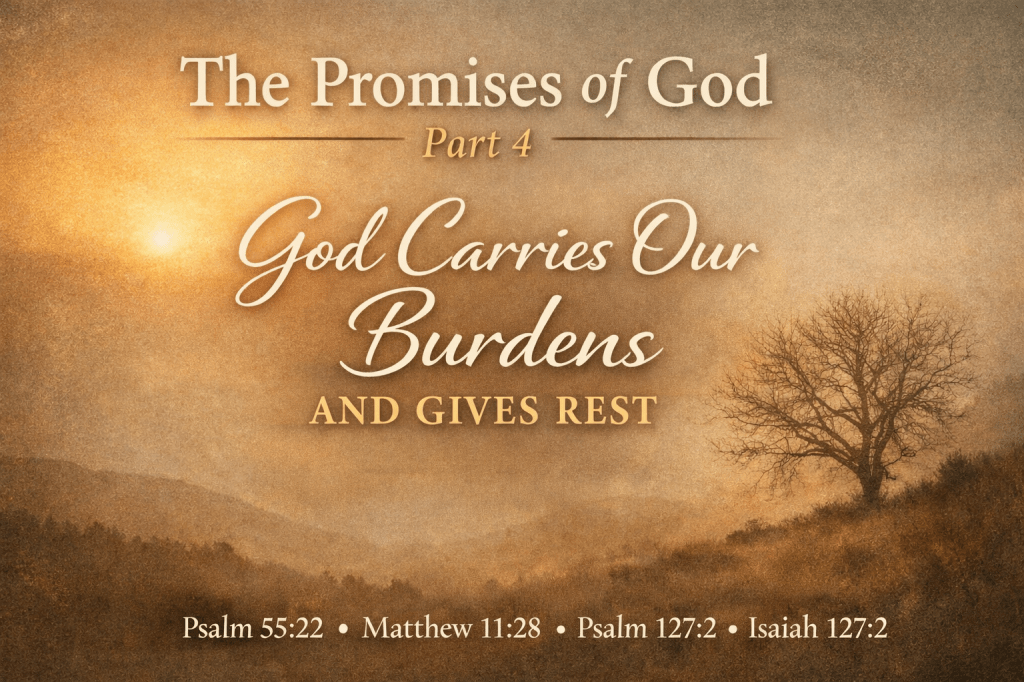
The Promises of God (Part 4): God Carries Our Burdens and Gives Rest

As we continue on in our study of the promises of God, we come to a promise that speaks directly to the weight many people carry in everyday life. Scripture acknowledges that life can place heavy burdens on the human heart, but it also teaches that God doesn’t intend for His people to carry those burdens alone.
Several passages remind us that God invites us to bring those burdens to Him.
One of the clearest statements of this promise appears in Psalm 55:22:

“Give your burdens to the LORD,
and he will take care of you.
He will not permit the godly to slip and fall.” (NLT)

The word “burden” can describe many different things. For many people, burdens include spiritual struggles like doubt, guilt, suffering, or fear. They can also include everyday pressures such as financial strain, family problems, or difficult circumstances that feel overwhelming.
Whatever form the burden takes, the instruction in this verse is the same: bring it to the Lord.

What It Means to Cast Our Burdens on God

Casting our burdens on the Lord isn’t just admitting that we’re struggling. It means bringing those concerns honestly before God in prayer and surrendering control to Him.
When we cast our burdens on the Lord, we lay everything before Him. We acknowledge that we can’t carry the weight on our own, and we trust that God knows how to handle what we cannot.
This kind of surrender can be difficult because it requires us to release control. But the promise attached to this command is that God will sustain us. He doesn’t simply listen to our burdens; He strengthens us so we can keep moving forward.

The Rest Jesus Promises

This same invitation appears in the words of Jesus in Matthew 11:28:

“Then Jesus said, ‘Come to me, all of you who are weary and carry heavy burdens, and I will give you rest.'” (NLT)

The rest Jesus promises here goes deeper than physical rest. It’s rest for the soul. It’s the peace that comes when worry, fear, and doubt are replaced with trust in God.
People often try to carry their struggles alone, believing strength means handling everything without help. But Jesus offers something very different. He invites those who are weary to come to Him.
True rest begins when we stop relying on our own strength and place our trust in Him.

Rest as a Gift from God

Another verse that reinforces this promise appears in Psalm 127:2:

“It is useless for you to work so hard
from early morning until late at night,
anxiously working for food to eat;
for God gives rest to his loved ones.” (NLT)

This verse frames rest as a blessing from God rather than something we have to earn. In a world that often celebrates exhaustion and constant activity, Scripture reminds us that rest isn’t weakness. It’s part of God’s design.
Sleep itself becomes a picture of trust. When we rest, we’re acknowledging that God continues working even when we aren’t. He understands our limits, and because He loves His people, He provides the rest they need while He continues His work behind the scenes.

The Heart of This Promise

When we think about all of these passages together, they reveal a consistent message. God doesn’t expect His people to carry life’s burdens alone. Instead, He invites them to bring those burdens to Him and trust that He will sustain them.
No matter how heavy a burden may feel, it’s never too heavy for God. He remains a constant source of strength and rest for those who turn to Him when life becomes overwhelming.

Please continue to use the Promises of God Study Tracker (included again below) to follow along with the verses we cover throughout the series. I have highlighted the passages that were covered in today’s post for quick reference.


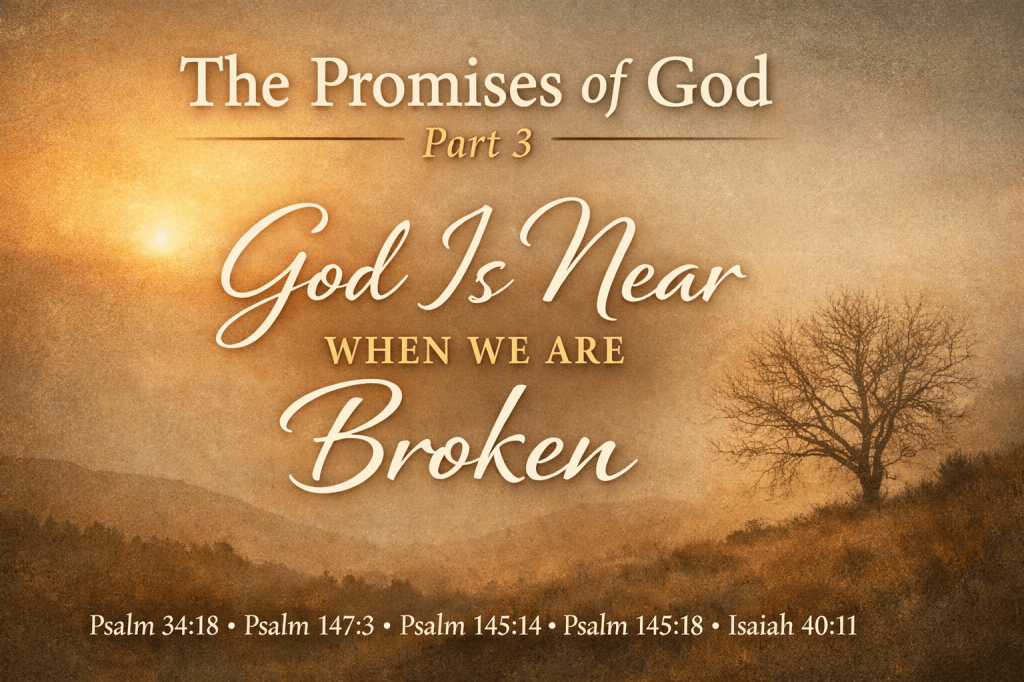
The Promises of God (Part 3): God Is Near When We Are Broken

As we continue this series on the promises of God, we’re beginning with some of the promises that speak directly to the hardest seasons of life. Scripture doesn’t ignore pain, discouragement, or exhaustion. In fact, many of God’s promises are given specifically for those moments when people feel like they’re at their lowest.
Several passages throughout Scripture teach the same promise. God draws near to those who are hurting.
One of the clearest statements of this promise is found in Psalm 34:18:

“The Lord is close to the brokenhearted; he rescues those whose spirits are crushed” (NLT)

When the Bible speaks about the “brokenhearted,” it’s describing people who are discouraged, spiritually exhausted, overwhelmed, or at the point of giving up. It can include grief, depression, deep disappointment, or the weight of circumstances that feel too heavy to carry.
Scripture doesn’t pretend those experiences don’t exist. Instead, it tells us something important about how God responds to them.

God’s Nearness in Pain

One misunderstanding people sometimes have about God’s promises is the expectation that God will remove every painful situation immediately. While God certainly has the power to change circumstances instantly, Scripture often describes something different. God promises His presence while we walk through the difficult times.
Psalm 34:18 doesn’t say that the brokenhearted will never experience pain. It says the Lord is close to them.
This means that even in seasons of discouragement or spiritual exhaustion, believers aren’t abandoned by their Father. God remains near to His people.

God Restores What Is Broken

Another verse that reinforces this promise is found in Psalm 147:3:

“He heals the brokenhearted and bandages their wounds.” (NLT)

Healing in this context isn’t limited to physical healing. It includes emotional healing and spiritual restoration. God doesn’t simply observe the wounds of His people. He restores what’s been damaged and strengthens what’s been weakened.
This healing may take some time, but Scripture assures us that restoration is part of God’s character.

God Supports Those Who Are Struggling

We also see this promise reflected in Psalm 145:14:

“The Lord helps the fallen and lifts those bent beneath their loads.” (NLT)

When someone is spiritually or emotionally overwhelmed, the Bible describes God as the One who lifts them up. Instead of pushing the struggling away, God supports them through the struggling.
The following verse continues this idea. Psalm 145:18 tells us:

“The Lord is close to all who call him, yes, to all who call on him in truth.” (NLT)

Again, the emphasis is on God’s nearness. When people seek Him sincerely, He draws closer to them.

The Shepherd Who Carries His People

One of the most beautiful pictures of this promise in the Bible appears in Isaiah 40:11.

“He will feed his flock like a shepherd.
He will carry the lambs in his arms,
holding them close to his heart.
He will gently lead the mother sheep with their young.” (NLT)

This imagery teaches us something important about God’s character. A shepherd protects and cares for his flock, and lambs that are weak or vulnerable are carried close for safety. In the same way, God protects His people and holds them close when they are struggling.
He doesn’t abandon those who are hurting. He cares for them.

The Heart of This Promise

Taken together, these passages reveal a consistent message throughout Scripture. God doesn’t turn away from those who are discouraged, spiritually exhausted, or overwhelmed.
Instead, He draws closer to them.
The promise we see repeated in these verses can be summarized this way: even when people feel they are at their lowest, God pulls them near and holds them close.
That promise reminds us that pain and discouragement don’t separate believers from God’s presence. In those moments, His nearness often becomes more evident than it ever has before.

To help you continue following along with this series, you can use the Promises of God Study Tracker introduced in the first post. Note that we will not be going through the promises in the order that they are listed. Instead, we will be covering all of the promises by splitting them up into groups based on theme. Keep watch for Part 4!

The Promises of God (Part 2): God Never Leaves Us

In the first post of this series, we talked about how God’s promises are rooted in His character. Before we can understand individual promises, we have to understand the One who makes them. God doesn’t speak casually, and He doesn’t break His Word. Ever.
Now, we’re beginning to look at specific promises from the list we’re studying together. The next promise we are going to dive into speaks directly to one of the deepest fears people carry in life: the fear of being abandoned.
Scripture tells us that God never leaves us.
We see this promise in Deuteronomy 31:8:

“The Lord himself goes before you and will be with you; he will never leave you nor forsake you.”

These words were originally spoken to the people of Israel as they were preparing to enter the Promised Land. Moses was reminding them that even though leadership was changing and they were stepping into unfamiliar territory, God Himself would go before them.
Their future wasn’t resting on their own strength. It was resting on God’s presence.

A Promise About God’s Presence

What stands out most to me in this verse is the reassurance that God will never fail us or abandon us. Human relationships can be unpredictable. People sometimes walk away, circumstances change, and life can shift in ways we didn’t expect.
But this promise reminds us that God’s presence isn’t temporary. He doesn’t step in only during the easy seasons and disappear when things get difficult. When God commits Himself to His people, He stays.
That truth runs throughout Scripture. From the beginning to the end of the Bible, we see God walking with His people through uncertainty, struggle, and even through their own failures.

When Waiting Feels Lonely

This promise became very real to me while I was waiting for my disability to be approved. That process stretched close to two years, and there were moments when the waiting felt heavy. When you’re living in uncertainty, it’s easy to start wondering how things are going to work out.
But during that time, we still had a roof over our heads and food on the table. God continued providing for our family day after day. Looking back, I can see clearly that He never left our side through that entire season.
Sometimes we expect God’s presence to look dramatic, but many times it show up in quiet faithfulness. Provision, protection, and endurance are often the evidence that He’s still walking alongside us.

A Promise That Speaks to Loneliness

One reason this promise matters so much to so many people is because loneliness is something nearly everyone experiences at some point in their life. Even people surrounded by family and friends can still feel alone in difficult seasons.
God’s promise speaks directly into that fear of loneliness.
Because of Christ, believers aren’t navigating life on their own. God’s presence isn’t distant or occasional. He walks with us through every season, whether we’re stepping into something new or waiting in a place that feels scary or uncertain.
That doesn’t mean life will always feel easy or comfortable, but it does mean that we’ll never need to face it alone.

The Heart of This Promise

If someone asked me why this promise matters so much, my answer would be simple. You never have to feel alone in this life because God will always be there by your side no matter what.
That truth becomes an anchor when circumstances feel unstable. God’s presence isn’t dependent on our emotions or our understanding of the situation. It rests on His faithfulness alone.
As we continue this series, we’ll keep returning to that foundation. Every promise we study points back to the same reality. God is faithful to His Word and faithful to His people.

To help you move through this series intentionally, you can use the Promises of God Study Tracker included below (also included in the first post of the series). It’s simply a tool to help you follow along, reflect on each promise, and keep notes as we study together.

The Promises of God (Part 1): Building on What God Has Actually Said

When we talk about the promises of God, we have to begin with something simple but important. Not every verse in the Bible is automatically a personal promise to us in the same way.
That doesn’t make Scripture weaker. It makes it deeper.
This series started because someone told me they wanted to know more about the Promises of God. As I was praying about where to begin, I realized I need to start adding some structure to my posts, not just scattered encouragement. So for this series, I’m using a compiled list of promise verses from The Bible Made Easy for Kids by Dave Strehler as a reference guide for which Scriptures we’ll study. I didn’t curate that list myself, but I will be teaching through each promise directly from the Bible using the correct context.
We’re going to talk about every single one of those promises at least once. Not speeding through them. Slowly. Carefully. Biblically.
And before we can get into specific promises, we need to lay a firm foundation.

A Promise That Started Under the Stars

One of the earliest covenant promises in Scripture is found in Genesis 15:5, when God tells Abraham to look up at the sky and count the stars if he can. Then He says, “So shall they seed be.”
Abraham didn’t have children yet. Sarah was barren. Years had already passed. From a strictly human perspective, it didn’t look very realistic to either one of them.
But the promise wasn’t dependent on Abraham’s biology, or even Sarah’s. It was dependent on God’s faithfulness.
That distinction matters.
The promise to Abraham was specific to him as part of God’s covenant plan that ultimately pointed to Christ. Not every promise in Scripture is universal in the same way. Some are specific. Some are conditional. Some are universal for all believers.
So how do we know which is which?
We study context.
We read carefully and intentionally.
We let Scripture interpret Scripture.
And we remember this anchor truth from 2 Corinthians 1:20:

“For no matter how many promises God has made, they are ‘Yes’ in Christ.”

Every true promise of God finds its fulfillment in Jesus.
That’s the lens we will look through for this entire series.

Why This Matters

I learned something about God’s promises while waiting almost two years for my disability to be approved. I kept reminding myself that God’s timing is perfect, but if I’m being 100% transparent, I struggled. A lot. There were days I felt patient and surrendered, and there were days I felt frustrated and doubted.
Waiting has a way of testing whether we trust God’s character or just prefer quick answers.
Ecclesiastes 3:11 says that He makes everything beautiful in His time. That doesn’t me we always understand the timing, but it does mean He isn’t careless or late.
God’s promises don’t expire because we’re tired. They don’t unravel because we stumble. They rest on who He is.
That’s what we’re building on.
In the next post, we’ll begin studying the first specific promise from our list and walk through it carefully in the correct context. By the end of this series, we’ll have talked about every promise on the list at least once.
We’re not just collecting comforting verses. We’re learning how to stand on God’s Word correctly.

To help us walk through this intentionally instead of casually, I’ve created a simple study tracker you can use as we move through each promise together.

Jesus Didn’t Throw Stones

I know Jelly Roll’s story. His past isn’t a secret. Drug dealing. Prison. Mental health battles. Years of brokenness lived out loud. So when I watched him stand on a national stage at the Grammys and boldly give glory to God, I didn’t see a performance. I saw a man on fire for Jesus. I saw sincerity. I saw passion. I saw a belief that ran deeper than anything for him in that moment. And it brought me to tears.
There was something holy about watching someone who knows where they came from openly testify about where God is taking them. It reminded me that God doesn’t wait for us to be cleaned up before He starts working. He meets us in the middle of the mess and begins transforming us from the inside out.
Then the next day came, and with it, a heartbreak I wasn’t expecting. I watched people who openly identify as Christians publicly tear him down. Not with discernment. Not with gentleness. But with judgment. The words that cut the deepest were people declaring that he isn’t a “real Christian.” As if that authority belongs to us. Scripture is clear that only Jesus sees the heart. Only Jesus knows the depth of someone’s repentance, sincerity, and relationship with Him. We don’t get to stand in that place.
This kind of public shaming damages the witness of Christianity more than we often realize. It paints believers as self-righteous and condemning, more eager to throw stones than to celebrate growth. For those who are curious about faith, new to church, or returning from a long time away, it sends a clear message: if you don’t fit a certain mold, you won’t be welcome here.
I know that fear personally. The visible tattoos on my body made me deeply hesitant to walk back into a church. I worried about how I would be perceived before anyone ever knew my heart. Even now, I sometimes second-guess choices like wearing makeup, jewelry, or pants, or dying my hair, despite having carefully studied the Bible on those things. Judgment has a way of lingering long after the words stop.
Scripture gives us a clear picture of how Jesus responds in moments like this. In John 8, a woman caught in adultery is dragged before Him, surrounded by people eager to condemn her. Jesus doesn’t deny that sin exists, but He refuses to join the mob. He tells them that whoever is without sin may throw the first stone. One by one, they walk away. Jesus, the only one qualified to condemn her, chooses mercy instead. “Neither do I condemn you,” He says. “Go and sin no more.”
That story reveals the heart of Christ. Grace first. Truth always. Condemnation withheld by the only one who had the right to give it.
If we have received that kind of grace, we are called to extend it.
Being Christlike means applauding growth and leaving the past where Jesus already buried it. It means being careful not to turn personal convictions into universal rules unless Scripture clearly supports them. When something can’t be supported by Scripture, we need the humility to say so, or we risk drifting into legalism disguised as holiness.
As representatives of Christ, our words should reflect His heart. We are called to speak with love, truth, grace, and humility, never with condemnation, hatred, or self-righteousness.
The body of Christ needs to remember that every one of us has sinned. The only perfect man is the one we are waiting for to return. No one stands above anyone else. When someone reads a Christian post and its comments or walks into a church, they should feel welcomed, loved, and embraced like family, not inspected or shamed.
If Jesus were standing here today, I believe His heart would be very heavy. Not because sinners are seeking Him imperfectly, but because His children are wounding one another in His name. Grace was never meant to be guarded like a private treasure. It was meant to be poured out, just as it was poured out on us.

Everything the Light Touches: Seeing God’s Truth Beyond our Comfort Zones

Would you rather listen than read?

I was sitting quietly, typing Scripture as part of my goal to type out the entire Bible, when I came across Genesis 13:14-15. As I read God’s promise to Abram, something unexpected happened. My mind immediately jumped to The Lion King and that familiar scene where Mufasa tells Simba that his kingdom will be “everything the light touches.”
And I had to smile, because apparently Disney has been sneaking theology into my childhood for years.
But the more I sat with it, the more something deeper settled in my heart. God’s truth has a way of showing up everywhere, often in places we don’t expect. That realization helped me understand why I’ve always felt reluctant to accept the idea that Christians must completely shut themselves off from all secular movies, music, or media in order to be faithful.
God doesn’t suddenly stop being God outside of explicitly Christian spaces.
Genesis 13:14-15 says, “Lift up your eyes and look from the place where you are…for all the land that you see I will give to you and to your offspring forever.” God invited Abram to look. To observe. To see. Not to fear what was before him, but to trust the God who was leading him.
That moment clarified something important for me: I can’t allow other people’s convictions to become my rulebook. Scripture shows us that God convicts His children individually, according to His plans and purposes for their lives. What the Holy Spirit convicts one believer to abstain from may not be the same for another, and that doesn’t make either one less faithful.
This doesn’t mean boundaries don’t matter. They absolutely do.
I’m not saying Christians shouldn’t have personal boundaries when it comes to what they watch, listen to, or allow their children to be exposed to. Discernment is essential. Wisdom is necessary. But discernment is not the same thing as fear, and wisdom is not the same thing as blanket rejection.
Sometimes, as Christians, we reject things too quickly simply because they are labeled “of the world,” without taking the time to test them through Scripture and prayer. Yet Scripture calls us to do exactly that.
1 Thessalonians 5:21 tells us, “Test everything; hold fast what is good.”
It doesn’t say to reject everything immediately. It says to test it. To examine it. To discern what is worth holding onto.
Jesus also warned us about quick judgments. In Matthew 7:1, He said, “Judge not, that you be not judged.” That doesn’t remove discernment, but it does caution us against assuming our personal convictions must apply universally to every believer.
This becomes especially important when we think about our children.
As Christian parents, we aren’t just raising kids who follow rules. We’re raising future adults who will have to make their own decisions. If all we teach them is what they’re not allowed to watch or listen to, without teaching them how to discern why, we just leave them unprepared to steward the free will God has given them.
We need to teach our children how to ask better questions:
Is this honoring God?
Is this drawing me closer to Him or pulling me away?
What does Scripture say?
Have I prayed about it?
One of the clearest examples of God shining through in the secular world is the song “He Lives in You” from the Broadway production of The Lion King. There are lines in the song that say, “He lives in you, He lives in me,” and “He watches over everything we see.” Every time I hear those words, my mind immediately goes to God.
The song speaks about presence, guidance, legacy, and something greater watching over what has been entrusted to us. While the writers may not have intended it as worship, those themes echo Scripture so clearly that it naturally turns my heart toward God rather than away from Him.
God’s truth isn’t fragile. It doesn’t disappear when we step outside of our comfort zones. When we’re rooted in Scripture, prayer, and discernment, we don’t have to hide from the world. We can engage with it wisely.
Everything the light touches belongs to Him.

Slowing Down in a Loud World: A Call to Discernment

Disclaimer:
This reflection is not intended to tell anyone what conclusions they should reach about current events. It is not written to stir outrage or to promote a political position. My purpose is to call believers back to Scripture, prayer, and discernment in a time when emotions are high and information moves quickly.

Would you rather listen than read?

We live in a time when reactions are immediate, emotions are intense, and discernment is often sacrificed for speed.
Recent events involving immigration enforcement, public protests/riots, and even a church being disrupted during its Sunday service have stirred strong responses in people. Opinions are forming quickly, posts are being shared rapidly, and narratives are spreading before many have even taken the time to pause, pray, and seek clarity.
What troubles me most right now isn’t just what’s happening, but how we’re responding. Emotional reactions, coupled with a lack of prayer and discernment, are allowing misinformation to spread like wildfire. Once misinformation takes hold, it fuels fear, division, and confusion, and the cycle just keeps repeating.
Scripture warns us about this kind of hastiness.
Proverbs 18:13 says, “If one gives an answer before he hears, it is his folly and shame.”
God calls his people to listen before responding. In a culture that rewards speed, Scripture reminds us that wisdom begins with hearing.
Ecclesiastes 5:2 reinforces this posture: “Be not rash with your mouth, nor let your heart be hasty to utter a word before God.”
Before we speak publicly, before we share or react, God invites us to come before Him first. Prayer is meant to guide our responses, not follow them.
This matters because Scripture is clear about where our trust should be placed.
Jeremiah 17:5 says, Thus says the Lord: ‘Cursed is the man who trusts in man and makes flesh his strength, whose heart turns away from the Lord.'”
This applies to all people. Media figures, politicians, activists, influencers, and even church leaders. None of them are meant to be our final authority. When we take information at face value simply because it comes from a confident or familiar voice, we risk shifting our trust from God to man.
This is something I’ve had to confront personally.
I’ve caught myself reacting quickly. I’ve had to slow down, research claims instead of just repeating them, and ask God to give me a clear mind to discern what’s true and what might just be a lie of the enemy. That process has required humility and intentional prayer.
The goal here isn’t agreement.
The goal is discernment.
Believers aren’t called to think identically, but we are called to seek God faithfully. Slowing down to pray and discern, even if we land somewhere different, honors God far more than reacting emotionally without wisdom.
James 1:5 reminds us, “If any of you lacks wisdom, let him ask God, who gives generously to all without reproach, and it will be given to him.”
Discernment is a gift God is willing to give when we ask.
We also have to recognize the spiritual battle beneath the surface. The enemy thrives on division because division creates vulnerability. When believers are divided and reactive, confusion spreads more easily.
My prayer is simple.
That we would slow down.
That we would pray for wisdom before speaking.
That we would test what we hear rather than absorb it uncritically.
That we would ask the Holy Spirit to guard our hearts and sharpen our discernment.
These are trying times, but they’re also refining times. Discernment isn’t optional for the believer. It’s essential.

To support this reflection, I’ve created a simple “Pause, Pray, Discern” checklist you can download and use before reacting, reposting, or forming a strong opinion. My prayer is that it helps create space for wisdom, Scripture, and discernment when emotions are running high.

When Silence Clarifies the Calling

PREFER TO LISTEN INSTEAD OF READ?

There’s been a quiet stretch here, and that silence wasn’t accidental.

Over the past several weeks, I stepped back from posting, not because the vision faded, but because God was doing deeper work beneath the surface. During this time, I was nurturing my new role as a children’s ministry leader at church, learning how to shepherd little hearts with patience, wisdom, and love. I was also doing something equally important but less visible: self-reflection.

I spent time asking hard questions. Questions that don’t come from insecurity, but from discernment.

Questions like:

How will I respond to negativity this year in a way that actually reflects Christ?

Am I walking in obedience, or am I chasing validation?

Is Rooted in Grace and Faith a calling…or just a desire to be seen?

Those questions required stillness. And stillness requires silence.

As I leaned into Scripture and prayer, I felt the Holy Spirit gently but firmly press on my heart. Not with condemnation, but with conviction. Conviction that this space, this ministry, this journey was never meant to be about visibility. It was meant to be about obedience.

I realized something important. If this had only been a personal project or a creative outlet, walking away quietly would have been easy. I could have closed the tab, moved on, and felt no weight about it. But the longer I stayed silent, the heavier that conviction became. Not guilt. Conviction.

And that was confirmation.

Conviction doesn’t come from ego. It comes from calling.

God wasn’t asking me to post more. He was asking me to return obediently. To speak again, not because I had everything perfectly figured out, but because obedience doesn’t wait for perfection. It responds to the nudge.

This season of quiet refined my motives. It reminded me that ministry often grows underground before it ever bears visible fruit. That tending to children, guarding my heart, and learning how to respond biblically to criticism and negativity are all part of the same calling. None of it is wasted. None of it is separate.

Rooted in Grace and Faith still exists for the same reason it always has: to point hearts back to Jesus, to walk honestly through faith, and to choose obedience even when it feels uncomfortable or unseen.

If you’ve been quiet lately, too, if you’ve stepped back to listen more closely, know this: silence doesn’t mean you’ve missed your calling. Sometimes it means God is clarifying it.

I’m stepping forward again, not with grand declarations or promises of consistency, but with a simple yes.

Yes to obedience

Yes to grace.

Yes to continuing the work God has already begun.

Obedience Doesn’t Take Holidays (But Grace Covers Busy Seasons)

Soft sunrise over the horizon representing gratitude and renewed obedience to God.

The past couple of weeks have been very full. Family time, holiday preparations, and the kind of joyful busyness that somehow makes the days disappear faster than expected. Somewhere between celebrating, cooking, and enjoying the people God has placed in my life, my posting rhythm took a short holiday break of its own.

I want to be honest before God. I recognize that I didn’t prioritize intentional time to share His word the way I should have. Not because God is counting posts, but because obedience matters. When God gives a calling, it’s something we steward carefully, even when life gets loud. I brought that conviction to Him with humility, trusting His promise that “If we confess our sins, He is faithful and just to forgive us and to cleanse us from all unrighteousness” (1 John 1:9).

At the same time, tonight is not meant to feel heavy. Tonight is a night of gratitude. The fact that we are here, standing at the close of another year, is evidence of God’s mercy. Scripture reminds us, “It is of the Lord’s mercies that we are not consumed, because His compassions fail not. They are new every morning” (Lamentations 3:22-23). Even busy mornings. Even distracted ones.

With New Year’s Day just around the corner, I’m stepping forward with renewed determination. Not driven by pressure or perfection, but by obedience. A simple, steady yes to the calling God has placed on my life to minister, encourage, and share His Word. Consistency isn’t about never stumbling. It’s about responding when God lovingly redirects our steps. As Scripture says, “The steps of a good person are ordered by the Lord” (Psalm 37:23), even when those steps need gentle correction.

So tonight, we celebrate. “This is the day which the Lord hath made: we will rejoice and be glad in it” (Psalm 118:24). We thank God for another year of life, growth, and grace. And tomorrow, I will show up again. Grateful. Willing. Committed to obedience.